
Modern drug discovery faces a fundamental challenge in accurately modeling molecular behavior at scale. As molecules become more complex, classical computational methods struggle to estimate molecular energy states with sufficient accuracy and within reasonable time and cost constraints. This limitation directly impacts early-stage drug research, where unreliable energy estimates lead to longer screening cycles, higher experimental failure rates, and increased R&D spend.
The Variational Quantum Eigensolver addresses this challenge by introducing a hybrid quantum and AI-driven approach to molecular energy estimation. VQE leverages quantum circuits to represent molecular structures in a way that is closer to their true physical behavior, while classical AI optimizers iteratively refine the model to identify the molecule’s most stable energy configuration.
In practice, VQE workflows begin with simple molecules such as Hydrogen or Lithium Hydride to demonstrate how molecular Hamiltonians can be evaluated using parameterized quantum circuits. A classical optimizer then adjusts the circuit parameters based on measured outcomes, progressively converging on the ground-state energy of the molecule. This hybrid loop allows organizations to explore molecular systems that are increasingly difficult to model using classical simulation alone.
From a business perspective, VQE has the potential to improve the accuracy of molecular screening, reduce dependence on costly trial-and-error experimentation, and shorten early-stage drug development timelines. More importantly, it provides a practical pathway for life sciences organizations to adopt quantum-ready workflows today, positioning them to take advantage of future advances in quantum hardware as they mature.
The Concrete Experiment
To make this discussion tangible, I focused on a deliberately small and well-understood molecular system. The goal here is not complexity, but clarity.
Molecule selection
The experiment uses simple molecules such as Hydrogen (H₂) or Lithium Hydride (LiH). These molecules are widely used in quantum chemistry research because their behavior is well studied, which makes them ideal candidates for validating quantum algorithms before moving to more complex systems.
Objective
The task is to compute the ground-state energy of the molecule using the Variational Quantum Eigensolver. This represents the lowest possible energy configuration of the molecule and serves as a foundational metric in molecular modeling.
Why ground-state energy matters
Ground-state energy is not an abstract academic concept. It has direct implications for real-world drug research and molecular design:
- It determines molecular stability and whether a structure is physically viable.
- It influences reaction pathways and how molecules interact under different conditions.
- It forms the basis for understanding protein–ligand interactions, which are central to drug binding and efficacy.
By starting with this minimal experiment, the intent is to demonstrate how quantum algorithms can be applied to problems that are directly relevant to pharmaceutical research, while keeping the scope small enough to focus on the core mechanics of the approach.
Experiment Walkthrough: VQE for Molecular Energy Estimation
This experiment demonstrates how the Variational Quantum Eigensolver can be applied to estimate molecular ground-state energy using a hybrid quantum and AI-driven workflow.
Problem Definition
Accurately estimating molecular energy becomes computationally expensive as molecular complexity increases. This limitation slows early-stage drug research and increases experimental cost. The goal of this experiment is to estimate ground-state energy using a scalable quantum-assisted approach.
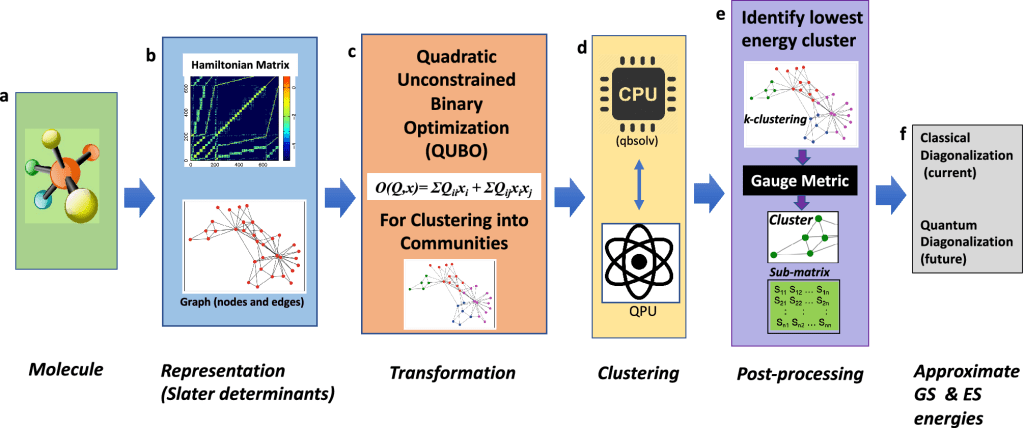
https://www.nature.com/articles/s41598-021-83561-x
Molecular Selection
Simple molecules such as Hydrogen or Lithium Hydride are used as benchmarks. Their known properties allow results to be validated while keeping the focus on the workflow rather than molecular complexity.
Hamiltonian Representation
The molecule is mapped to a Hamiltonian that captures its energy interactions. This step translates chemical structure into a form suitable for quantum evaluation and directly impacts result accuracy.
Quantum Ansatz
A parameterized quantum circuit is constructed to represent an approximate molecular wavefunction. The circuit parameters are adjustable, allowing exploration of different molecular configurations.
Hybrid Optimization Loop
The quantum circuit is executed to measure energy expectations. A classical AI optimizer then updates circuit parameters to minimize energy. This loop repeats until convergence, illustrating how quantum execution and classical optimization work together.
Outcome and Relevance
The final result approximates the molecule’s ground-state energy. More importantly, the workflow demonstrates how hybrid AI and quantum methods can address molecular modeling challenges that strain classical approaches. This provides a practical foundation for quantum-ready drug discovery pipelines as quantum hardware continues to mature.
Practical Ways to Implement VQE on IBM, Azure, and Google Cloud
The Variational Quantum Eigensolver is a hybrid algorithm by design. It combines quantum execution for energy evaluation with classical optimization loops. Because of this, all major cloud providers support VQE today, primarily through simulators first and selectively through real quantum hardware.
Below is a practical view of how VQE can be implemented across IBM, Azure, and Google Cloud, focusing on what teams can realistically build and operate today.
IBM Quantum (IBM Cloud + Qiskit Runtime)
IBM provides the most mature end-to-end environment for running VQE, particularly through Qiskit Runtime, which is optimized for iterative hybrid workloads.
What to use
- Qiskit Runtime primitives such as Estimator and Sampler
- Runtime Sessions to efficiently execute iterative VQE loops
- Qiskit Serverless and Patterns for managed and repeatable execution
- Quantum chemistry with VQE
Practical implementation path
- Develop and validate the VQE workflow locally using Qiskit simulators
- Move the Hamiltonian expectation value evaluation to Qiskit Runtime using the Estimator primitive
- Execute the full optimization loop within a Runtime Session to reduce latency and overhead
- Package the experiment as a managed job for repeatable runs and benchmarking
Where IBM fits best
IBM is well suited for teams that want a clean hybrid quantum runtime experience today and a direct upgrade path to IBM quantum hardware when required.
Azure Quantum (Azure Workspace + Python SDK)
Azure Quantum acts as a control plane that integrates quantum programming frameworks with enterprise-grade cloud governance.
What to use
- Azure Quantum Workspace
- azure-quantum Python SDK
Practical implementation path
- Create an Azure Quantum Workspace and configure target providers
- Build the VQE workflow locally using Qiskit or Cirq
- Keep the classical optimizer in your Python environment and submit quantum circuit evaluations through Azure Quantum
- Scale experiments using Azure guidance for long-running and hybrid workloads
Where Azure fits best
Azure Quantum works well for enterprises that want centralized governance, security, and the flexibility to route workloads across multiple quantum providers from a single platform.
Google Cloud (Cirq + qsim on GCP)
Google Cloud’s most practical quantum offering today is high-performance simulation using Cirq and qsim, with limited access to real quantum hardware.
What to use
- Cirq framework
- qsim simulator
- Running Cirq and qsim on Google Cloud infrastructure
Practical implementation path
- Deploy a Jupyter-based environment on a Google Cloud VM
- Run Cirq circuits using qsim for fast and scalable simulation
- Execute the VQE hybrid loop with the classical optimizer running on the same VM or managed compute
If approved, submit jobs to Google Quantum Engine using restricted access
Where Google fits best
Google Cloud is ideal for teams that want high-performance quantum simulation at scale today and plan to explore Google hardware later when access is available.
Closing Thought
VQE is not a future-only algorithm. It is already implementable today using cloud-based hybrid workflows. The real value lies in building quantum-ready pipelines now using simulators and managed runtimes, so organizations are prepared to scale seamlessly as quantum hardware continues to mature.
 Quantum Frontier
Leave a comment