
Microsoft has recently announced their public preview of stable quantum computing environment – Azure Quantum, which emcomposes the power of a super computer and delivers in your finger tips. Scientist and research are celebrating this breakthrough as this is going to open up a series of new possiblities and help them solve the complex algorithms and discover new algorithms.
Unilever is annoucing Generative Chemistry and Accelerated DFT (Density functional theory **) which will expand the ways researchers can harness the power of quantum computational modeling method using practical tools.
Unilever scientist are planning to use Azure Quantum platform to broaden their exploration in novel molecules study in specific industry applications using AI Models trained on hundreds of millions of compounds and then evaluate the steps suggested by the workflow for synthesizing the most promisin candidates in a lab more efficiently in a matter of days not years.
“Digital tools are unlocking an unprecedented age of scientific discovery. Using advanced computing power and AI, we are able to compress decades of lab work into days, accessing a level of insight we could not previously have imagined. This technological leap, coupled with our vast repository of proprietary data and a century of expertise in personal and household care, means our scientists are able to lead the industry in developing the next generation of consumer goods.”
— Alberto Prado, Global Head of R&D Digital and Partnerships at Unilever
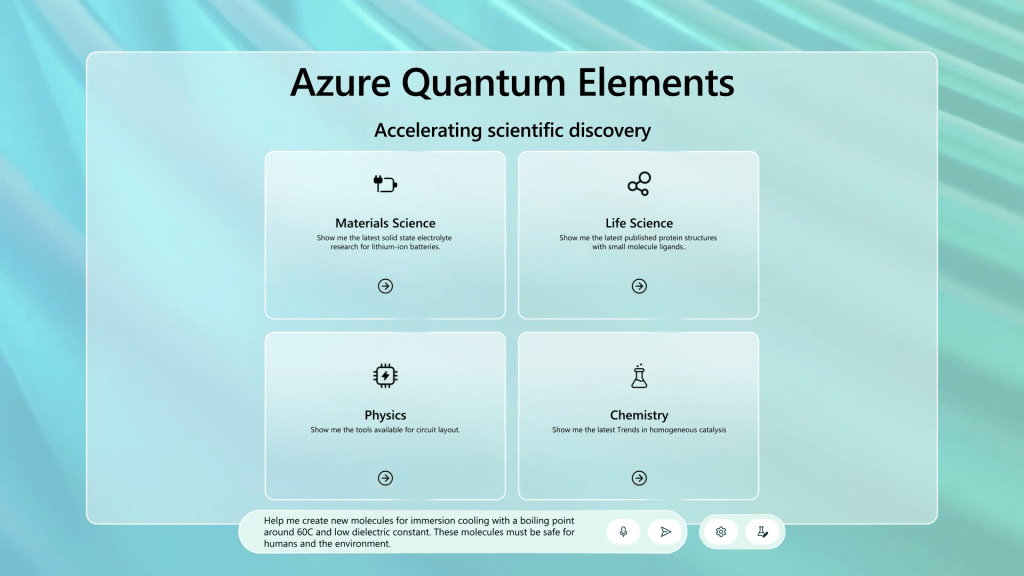
The introduction of Generative Chemistry aims to ignite a new era of creativity in molecule discovery. This technology can be likened to replacing a tiny flashlight in a dark warehouse with a smart light that reveals hidden areas. Generative Chemistry enables scientists to discover stronger fuels, better adhesives, and more by simply describing their desired molecular characteristics. The AI then suggests potential candidates that meet those criteria.
Beyond generating ideas, these AI tools help scientists find new, useful, and synthesizable molecules. The integration of capabilities from AutoRXN software offers step-by-step guides for synthesizing these new molecules in the lab, accelerating the journey from hypothesis to lab-ready molecule candidates.
Additionally, Microsoft is introducing Accelerated DFT (Density Functional Theory), a powerful tool for simulating and studying the electronic structure of molecules. This can be compared to getting a helicopter view of a busy traffic system, simplifying the complex interactions of electrons. The managed DFT service significantly speeds up these calculations, making them accessible even without supercomputer resources.
Accelerated DFT is already benefiting organizations like AspenTech and Unilever, helping them expedite research in areas such as sustainable energy and therapeutics.
With these innovations, Microsoft is making it easier and faster for researchers to discover and develop new molecules, paving the way for breakthroughs in manufacturing, medicine, and beyond.
Azure Copilot Studio helps accelerating the research by providing easy to use intelligent generative chat application grounded on the organizations data.

Exciting times, looking forward to see Quantum technologies reshape the world.
– Content summarized by Denesh Mani
** Density functional theory (DFT) is a computational quantum mechanical modelling method used in physics, chemistry and materials science to investigate the electronic structure
 Quantum Frontier
Leave a comment